Our approach in a nutshell
Learning and teaching at Sophia College is underpinned by our mission and vision, and supported by the Brisbane Catholic Education Learning and Teaching Framework — student centric, data informed, curriculum aligned, and evaluating teaching as well as learning. Our learning ecology is connected to faith, to a curriculum that reflects the world we live in, to passionate and collaborative teachers, to the Lockyer Valley community, and to the wider world our students will go on to shape.
Teachers at Sophia College are Passionate, Collaborative and Innovative. Drawing on Hattie's (2016) teacher mind frames, we aim to:
- See ourselves as evaluators of our impact, and as change agents
- Talk about learning, not just teaching
- See assessment as feedback to us, not just about students
- Engage in dialogue, not monologue — and enjoy challenge
- Use the language of learning, and see learning as hard work
- Collaborate, and build positive relationships
In the middle years especially, our approach is grounded in constructivism — students are capable learners who construct understanding and bring diverse experience to the classroom. Years 11–12 follow QCAA's Teaching, Learning and Assessment Plans (TLAPs).
The BCE Model of Pedagogy
"Teaching for Learning" is a living model that supports educators to make effective decisions about their practice — underpinned by the science of learning, and placing the student at the centre of the journey.
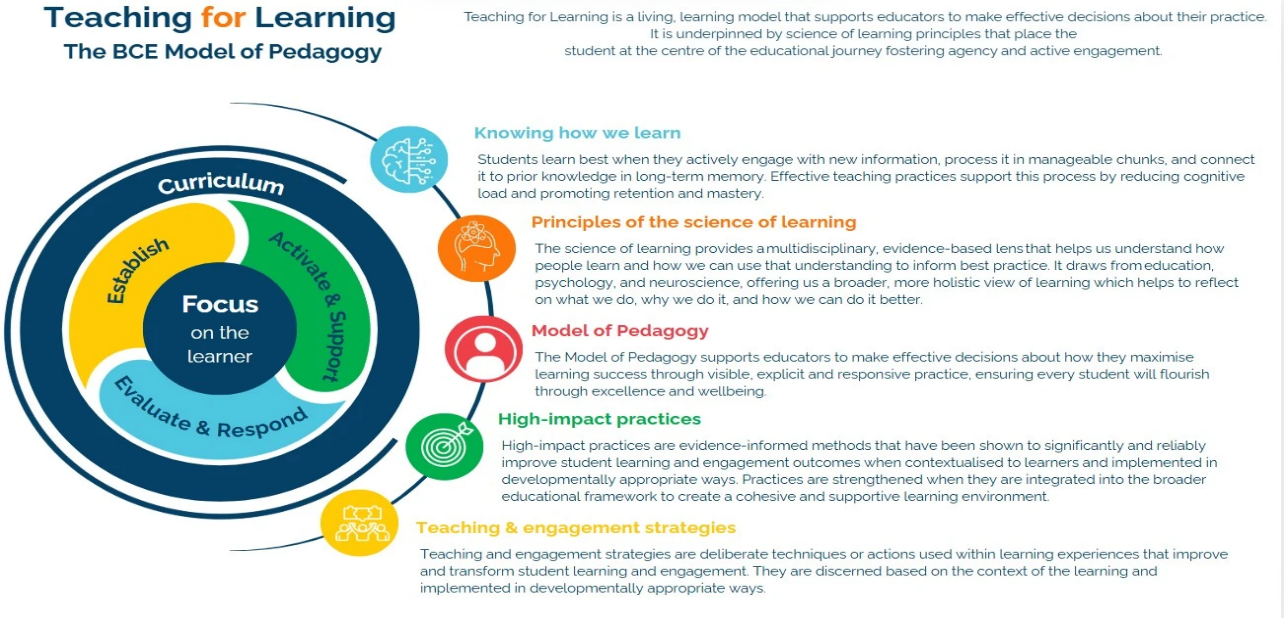
Source: Brisbane Catholic Education (2025), Teaching for Learning – The BCE Model of Pedagogy.
Five elements frame the model:
Curriculum
Focus on the learner
Establish the conditions and expectations for learning and wellbeing
Activate and support learning experiences
Evaluate impact and respond
The Mastery Journey at Sophia College
We identified a growing concern around student engagement and restlessness, often showing up as inappropriate behaviour and lost learning time. Learning is only as effective as the culture, expectations, routines and rules that are explicitly taught and consistently reinforced. Classroom Mastery and our AERO partnership are independent programs, but both draw on proven, evidence-based strategies — Sophia integrates elements of both.
| When | What happened |
|---|---|
| 2023/2024 | Developed the Triple R Process and established the Re-Engagement Room — a reminder of expectations and a chance to reflect away from the classroom. |
| 2025 | Introduced Classroom Mastery (initial focus: entry/exit routines, cue to start, movement routines) and partnered with AERO to strengthen Learning Mastery across Years 7–8. |
| 2026 | Progressively rolling out I Do/We Do/You Do, Learning Intentions/Success Criteria, and chunking — continuing into 2027. Every second Monday staff meeting is now a Community of Practice (CoP). |
| 2027 & beyond | Inquiry Mastery joins the journey once Learning Mastery is consolidated. |
Explicit Inquiry Road Map
| Classroom Mastery (Explicit) | Learning Mastery (Explicit) | Thinking Mastery (Inquiry) | |
|---|---|---|---|
| Includes | Entry routines, Cue to Start, Exit routines, Student movement routines | Learning Intentions/Success Criteria, Explicit Instruction (Do Nows; I Do/We Do/You Do; lesson icons; learning voices), Checking for Understanding, Chunk learning | Extend and challenge, Modes of inquiry, Thinking routines, Thinking in action |
| Timing | 2025 onwards, Years 7–12 | 2026/2027, working towards Years 7–8 — other year levels invited to join, whole-school by 2027/2028 | Once Learning Mastery is consolidated |
Further reading: AERO (2023), How students learn best (pages 8–17) — edresearch.edu.au/resources/how-students-learn-best.
Classroom Mastery
Classroom Mastery is an evidence-based program (co-developed with Dr Tim McDonald, implemented in 150+ Australian schools) that helps build calm, orderly, productive learning environments through explicit teaching of expectations, routines and rules. It offers twelve strategies — Sophia's initial focus is these four:
What it is: a structured sequence students follow every time they enter — an orderly, safe, focused start to learning.
How to use it: use Cue to Start for attention, then: line up in pairs outside → enter silently, one line at a time → stand silently behind desks → place all equipment (including hat) on desks → greet the class (they greet back) → instruct students to sit and begin the starter task.
Script: "Your safety and learning matter. To help us start every lesson well, we will use the same entry routine. You will line up in pairs, enter silently, stand behind your desks, and place your equipment on the table. I will greet you, you will respond, and then I will ask you to sit. Let's practise this together."
What it is: a consistent verbal + physical signal (hand raised, 3–2–1 countdown) to get every student's full attention before instructions.
How to use it: stand centrally and visibly → raise your hand, count 3–2–1 → pause and scan the room → wait for 100% attention → if a student isn't ready, name them respectfully, wait, then thank them.
Script: "When I say 3–2–1 and raise my hand, you will stop what you are doing, look at me, have nothing in your hands, and place your laptop in Pac-Man mode. I will know you are listening when you are looking at me." Daily use: "3–2–1… I know you're listening when you're looking at me. Thank you."
What it is: a predictable procedure for how students move within the room — transitions, materials, group work, or relocating.
How to use it: use Cue to Start → give a brief, precise direction (e.g. "row 1 will move to the front table to collect a worksheet, then return to your seat") → model where needed → release groups in controlled order → scan and give feedback.
Script: "3–2–1… thank you. Row 2, you may collect your laptops. Walk, don't talk. Row 3, be ready."
What it is: a structured routine for safe, calm, organised dismissal at the end of a lesson.
How to use it: Cue to Start → students write homework → clean and reset their area → pack away equipment → stand silently behind desks with hats on → teacher thanks the class (class responds) → dismiss silently, row by row.
Script: "Cue to Start… thank you. Please pack away your books and equipment. Stand behind your desks when ready. Good afternoon, Year X — thank you for your effort today. Rows 1 and 4, you may leave."
Classroom set-up
Set seating plans are required for all Years 7–8 classes, to establish routines and expectations from day one.
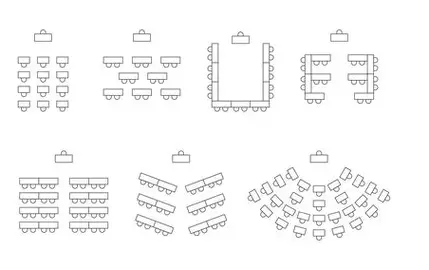
- Layout: support predictable entry/exit/transitions, define learning zones, minimise distractions, and support gaining whole-class attention quickly
- Flexible grouping: clusters/pods for collaborative tasks, with clear expectations and routines explicitly taught first
- Seating plan: used strategically — proximity to role models/support peers, reducing off-task behaviour, and enabling strategies like Turn & Talk
- Agile spaces: start from the learning intention, choose the arrangement that suits the activity, and explicitly teach expectations for moving/working in that space
Learning Mastery
Learning Intentions
State what students are expected to know and understand — not just what they'll do — as a clear, student-friendly "We will …" statement, aligned to ACARA v9/QCAA content descriptors. Start from the curriculum, identify the core concept/skill, then pick the cognitive verb that matches the thinking demand:
| Thinking demand | Example verbs |
|---|---|
| Retrieval (remember/recognise) | identify, list, recall, define, label |
| Comprehension (organise/interpret) | describe, summarise, explain, sequence, compare |
| Analysis (break down/relationship) | analyse, examine, infer, distinguish, justify |
| Knowledge utilisation (apply/solve) | apply, decide, evaluate, create, represent, synthesise |
e.g. "We will explain how photosynthesis converts light to chemical energy." Keep it visible on the board/OneNote throughout the lesson, and revisit it at the end: "Can you show or explain how you have achieved today's goal?"
Success Criteria
Describe what success looks like against the Learning Intention, as an "I can …" statement — more concise than the intention, and written as observable "minor cognitions" rather than a checklist of activities (e.g. for explain: "I can name inputs/outputs," "I can connect steps in order," "I can use scientific vocabulary correctly"). Keep them visible and refer back to them for self-assessment, peer feedback and review.
Explicit instruction
The gradual-release sequence used at Sophia College:
Explanation
Model
Think Aloud
I Do
We Do
You Do
Scaffolding
Checking for understanding
Rosenshine (2012): checking for understanding tells you what students know and can do, surfaces gaps, and lets you adjust teaching. Sophia College's shared strategies:
A short (2–5 min), focused task at the very start of the lesson to activate prior knowledge and settle students in — especially effective as a literacy warm-up (vocabulary review, sentence construction). Displayed on the board/OneNote as students enter, started immediately.
Example: a "Unit Vocabulary Acrostic Matrix" — spell the unit title down the centre of a grid, then fit key vocabulary words around it, one letter per row.
Ask the question first, pause and scan for wait time, then name a student — not just hands up. This isn't punitive; it builds a culture where everyone's expected to think, not just the confident/quick. Use a randomiser (name sticks/wheel), vary who you call to ensure equity, and use "no opt out" — if a student's unsure, come back to them rather than moving straight to someone else.
Script: "Let's check for understanding. I'm going to ask a question, and then I'll call on someone to answer... Jordan, can you share your answer?... Thank you, Jordan. How did you figure that out?"
Checks understanding of explicit instruction — not the same as an open Think-Pair-Share brainstorm. Requires a set seating plan with Partner A/B roles, a different task/question for each partner, thinking time, then structured sharing. Both partners must contribute — "I don't know" isn't an option — and either partner may be asked to share their own or their partner's answer via Cold Call.
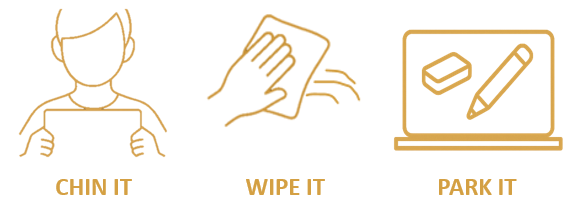
One response per board. Sequence: pose the question → students write (silent voice, work covered) → "Chin it" on a 3-2-1 count (board held at chin, not higher — so you can see behind it) → scan and respond, students "tick it or fix it" → "Wipe it" → "Park it" when not needed (marker/eraser on top, pushed to the top of the desk, hands in lap).
Misuse (e.g. colouring in, not participating) escalates: verbal reminder → warning with a choice (use the MWB or lose the privilege) → loss of privilege (student completes responses in their exercise book instead, RRR warning for not following direction) → if repeated, a conversation about respecting learning tools and RRR/parent follow-up.
A short written response at the end of a lesson/sequence — quick formative data, and it helps students retrieve and consolidate what they've learned. Keep prompts focused, concise, and tied to the Learning Intention/Success Criteria; give 2–3 minutes.
Example formats: Thumbs Up/Down/Sideways; a Red/Yellow/Green traffic-light check-in; emoji check-ins; a 4-3-2-1 proficiency scale; "draw it"; "what stuck with you today?" on a Post-it; a 3-2-1 (three things learned, two still working on, one question); or a quick digital Forms quiz.
Learning Voices
Explicitly taught and modelled — all levels taught together so students can see them in relation to each other:
| Voice | When |
|---|---|
| Silent Voice | No talking — listening only, or independent work |
| Partner Voice | Quiet talk with your partner, not loud enough to distract others |
| Group Voice | One person talking, others listening, in small groups |
| Class Voice | Whole-class discussion, respectful, audible on Call to Attention |
Lesson Icons
A shared set of visual icons — Call to Attention, Do Now, Note taking, Cold Calling, Turn & Talk, Mini Whiteboard, Chin it/Wipe it/Park it, I Do/We Do/You Do, the four Learning Voices, Learning Intention, Success Criteria, Exit Slip, Proficiency Scale, Timer, Page Number, and Think-Pair-Share — used consistently on slides/boards across every classroom. AERO identifies this shared visual language as a key enabler of effective whole-school implementation: it reduces cognitive load and helps every student (especially those who benefit from visual prompts) know what's expected.
Chunk learning
Break complex content into smaller, meaningful chunks so students master one step before the next — reducing cognitive load and supporting working memory. Present each chunk with clear explanation/examples, check for understanding before moving on, and connect it back to the bigger picture.
Thinking Mastery & Inquiry Learning
The third pillar of Explicit Inquiry — planned for once Learning Mastery is consolidated across the College (see the Road Map above). It will include:
Extend & challenge
Modes of inquiry
Thinking routines
Thinking in action
Detailed instructional routines for Thinking Mastery weren't yet documented as of the current Playbook. Check with your Pedagogy Companion for the latest.
Communities of Practice (CoPs)
Formerly called PLCs (Professional Learning Communities) — same structure, now branded Communities of Practice.
CoPs are Sophia College's primary vehicle for collaborative professional learning — structured teams of a mix of CLT, Middle Leaders and teachers across teaching areas, led by a CoP Coach. Every second Monday staff meeting is a CoP. They're grounded in the AERO coaching cycle:
Plan
Identify a focus area from student needs, set clear goals.
Model
Share or demonstrate effective strategies and resources.
Practise
Trial new approaches in your own classroom, with peer/coach support.
Observe
Coaches observe practice and give feedback on the focus routine.
Reflect
Share evidence of impact, analyse outcomes, plan next steps.
Meeting norms
- Purpose & focus: student learning and wellbeing stay central; work is anchored to a clear focus question, not just conversation
- Preparation & participation: attend punctually and prepared, bring evidence (work samples, data), share responsibility for every student's learning — not just your own classes
- Evidence-informed inquiry: decisions come from evidence and data, not opinion — stay open to feedback and challenge
- Respect, trust & confidentiality: focus on practices and strategies, not individuals
- Accountability: leave with clear next steps, implement them, report back honestly
- Time & structure: honour start/finish times, use structured agendas, park unrelated matters
Planning & the 4Cs
Adapted from Fullan & Sharratt (2012):
Co-Plan
Work collaboratively to identify and improve an aspect of teaching practice.
Co-Teach
Deliver the co-planned lesson and identify its impact.
Co-Debrief
Examine and discuss the lesson's effectiveness together.
Co-Reflect
Identify next steps for your own learning and practice.
Our planning aims for Clarity, Collaboration, Consistency, Compliance and Accountability, moving through: Curriculum Map → Collaborative Unit Plan → Individual Class Unit Plan → Teaching → Assessment → Review & Reflection.
| Document | Responsibility | Due |
|---|---|---|
| Curriculum Maps | Teaching team | Start of school year |
| Unit Plans | Class teacher, with teaching team | Before the start of each cycle |
| Assessment Tasks | Teaching team | End of Week 3 |
| Adjusted Assessment Task | Class teacher with ST:IE | End of Week 3 |
Curriculum Maps and Unit Plans live in the Sophia College Learning and Teaching Portal (SharePoint) — avoid downloading and working offline so everyone's using the current version.
AI in the classroom
All staff have access to Microsoft 365 (including Copilot) through BCE. Students 13+ are also gaining Copilot access for school activities. Staff may currently use AI tools to help plan lesson activities aligned to ACARA/QCAA standards, and to support drafting feedback on student work.
- You must have read and engaged with the student's work in full yourself
- Feedback must be checked against the correct syllabus/criteria/ISMG
- AI-assisted feedback must be edited, refined or rejected as needed — it reflects your professional judgement, not the AI's
- Be transparent where appropriate (e.g. "This feedback was drafted with AI support and reviewed by your teacher")
Assessment, moderation & reporting
See Assessment & Missed Work for the full policy. In brief:
- Moderate results with colleagues before students receive grades/feedback — bring a top, an at-standard, and an on-the-cusp sample
- Aim to return results and feedback within 2 weeks
- Reports are written twice yearly in SRS (Student Reporting System) for the Parent Portal — grades shouldn't be a surprise to any student or parent
The report-writing timeline (data entry → drafting → proof-checking → verification → publishing) runs on a strict weekly schedule each term — check the current 2026 Report Writing Guide on SharePoint for exact dates.
Learning data we collect
PAT R, PAT M, Writing Analysis Tool, Data Walls, Review and Response, and NAPLAN Online.
Learning at home
Suggested guidelines: Year 7 ≈ 10–15 minutes per subject between lessons; Year 8 ≈ 15 minutes per subject. Confirm the Year 9–12 guidelines.
Inclusion & differentiation
The best place for learning is in the classroom with the class teacher and peers. Students needing significant adjustment beyond good first teaching are usually identified from enrolment onward — our ST:IEs and leadership work with families through the Enrolment Application and Support Process (EASP). This connects directly to NCCD and the Disability Standards for Education (2005), which require Australian schools to ensure students with disability can access and participate on the same basis as their peers, with reasonable adjustments made in consultation with the student and their family.